

Creative Portrait Photography: The Magic of the Fujifilm GF 110mm f/5.6 T/S
New Dimensions in Portrait Photography with the Fujifilm GF 110mm f/5.6 T/S
Tilt-shift lenses are often confined to architectural photography – but they are a secret tip for extraordinary, creative portraits. Instead of capturing the entire face sharply, the tilt of the lens allows for radical control over the plane of focus.
The Physics Behind It: The Scheimpflug Principle
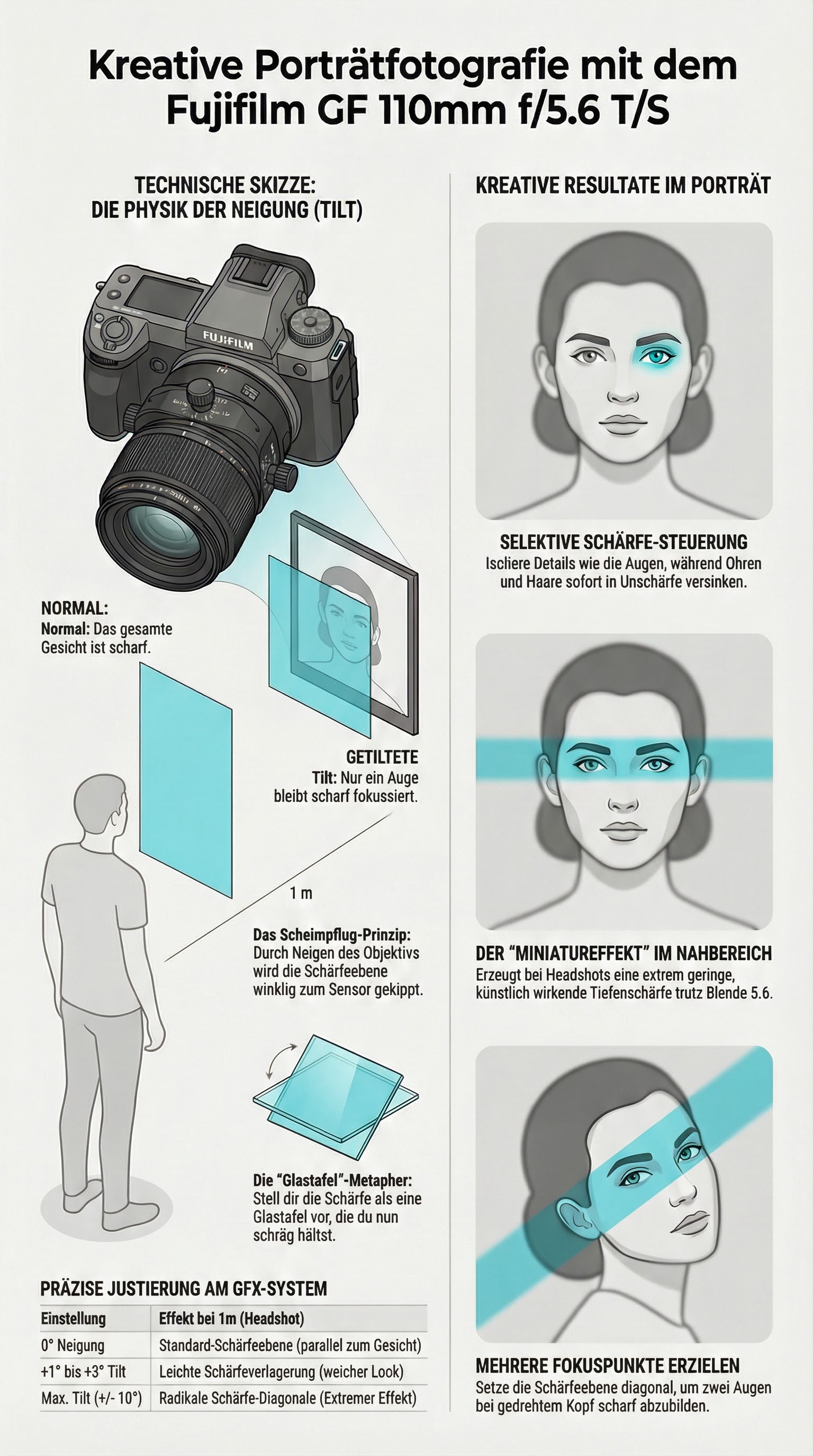
The "Glass Pane" Metaphor: As illustrated in the infographic, you can best imagine the plane of focus as an invisible glass pane. Usually, this runs parallel to the sensor and thus parallel to the subject’s face. By tilting the lens, this "glass pane" is angled toward the sensor. It essentially slices diagonally through the space. Suddenly, for example, only one eye is in focus, while the rest of the image gently blurs.
Practical Examples in the Studio
To demonstrate how extreme this effect is, I show here two real shots with the Fuji GF 110mm f/5.6 T/S. In both images, the model is holding their head slightly lowered.
1. Tilted Parallel to the Head Posture

In the first image, I aligned the tilt plane exactly parallel to the inclined head posture. The result: Although the head is lowered and we are working with an aperture of f/5.6, almost the entire face lies in a perfect, continuous zone of sharpness.
2. Tilted Opposite to the Head Posture

Here, the tilt function was deliberately angled against the natural head posture. The plane of focus now cuts through the face in only a tiny, diagonal slit. The sharpness runs thinly through the eye area and part of the hair, while the rest of the head – chin, nose, shoulders – sinks into an extremely soft, almost artificially looking blur. A magical look that is hard to authentically simulate with software.
Three Creative Results at a Glance
1. Selective Sharpness Control
You can selectively isolate details like only the eyes sharp, while ears and hair immediately sink into deep blur.
2. The "Miniature Effect" in Close Range
Even at f/5.6, you create an extremely shallow, organically looking depth of field in headshots. This inevitably draws the viewer's eye to the essentials.
3. Achieving Multiple Focus Points
If the model’s head is slightly turned, you can lay the plane of focus diagonally to get both eyes sharply in focus, even though they are at different distances from the camera.
This technique is perfect to give traditional headshots or creative portraits in Mallorca a completely unique and three-dimensional look.
No Autofocus
An essential point: This lens is purely manual. It is fully electronically connected to the camera, so you see all settings both in the camera display and in the EXIF data. But you have to focus manually. Especially with the GFX 100 II, this is not a dramatic challenge, as the focusing assistance for manual lenses through focus peaking, adjustable magnification, or simultaneous display of a magnified view and the image section in which it is located, are enormously helpful. But: You always need to ensure that you precisely focus (usually on the nearest eye). And thereby, you might lose a bit of the emotional connection to your subject.
Conclusion
The lens is really fun and offers enormous and fascinating possibilities to create an unusual perspective on classic portraits. Of course, you need to spend some time with it initially. Perhaps doing a few trial shoots with friends or acquaintances. Or patient clients. I initially took an hour before feeling somewhat confident with it. I would rather not have experienced that with a real client.
Whether the acquisition is worthwhile is naturally an individual decision. This new lens may not quickly become cost-effective, as it is perhaps questionable whether you will receive more or better jobs because of this lens alone. But perhaps you can also differentiate yourself and stand out from the competition with it. As I said: This is certainly individual and everyone needs to reflect on it themselves...
Comments (0)
No comments yet. Be the first!
Leave a comment
More Posts

Why AI in Street Photography is My Key Partner
Discover how AI sharpens my vision in street photography, often surprising me with its insights and enhancing my creative process.
sigma 135mm 1.4 vs sony 135mm 1.8
two systems, one sensor sony a7r5, LEICA SL3a real-world comparison from palma ">a practical review where i share m...